
The new Zan Zone album, The Rock Is Still Rollin’ is presented as a tribute to Rock n’ Roll music’s first three decades, as it was created and - more-or-less - and as it sounded, but with modern recording techniques utilized. Interestingly, some sounds in the early years of Rock n’ Roll, are as good as anything recorded today and often, artists are hoping to capture some of that wonderful sound quality in 1950s, and 1960s vocal sounds.
By the 1970s, everything was leveling out, sound-quality wise. However, in those first two decades especially, while the vocals were hot - the drum sounds were not! It wasn’t until the late 1960s before drum sound quailty began to be fully realized.
Anyway - to read about what this album is really all about, head to the “TRISR Essay” page for the full-scale discussion!
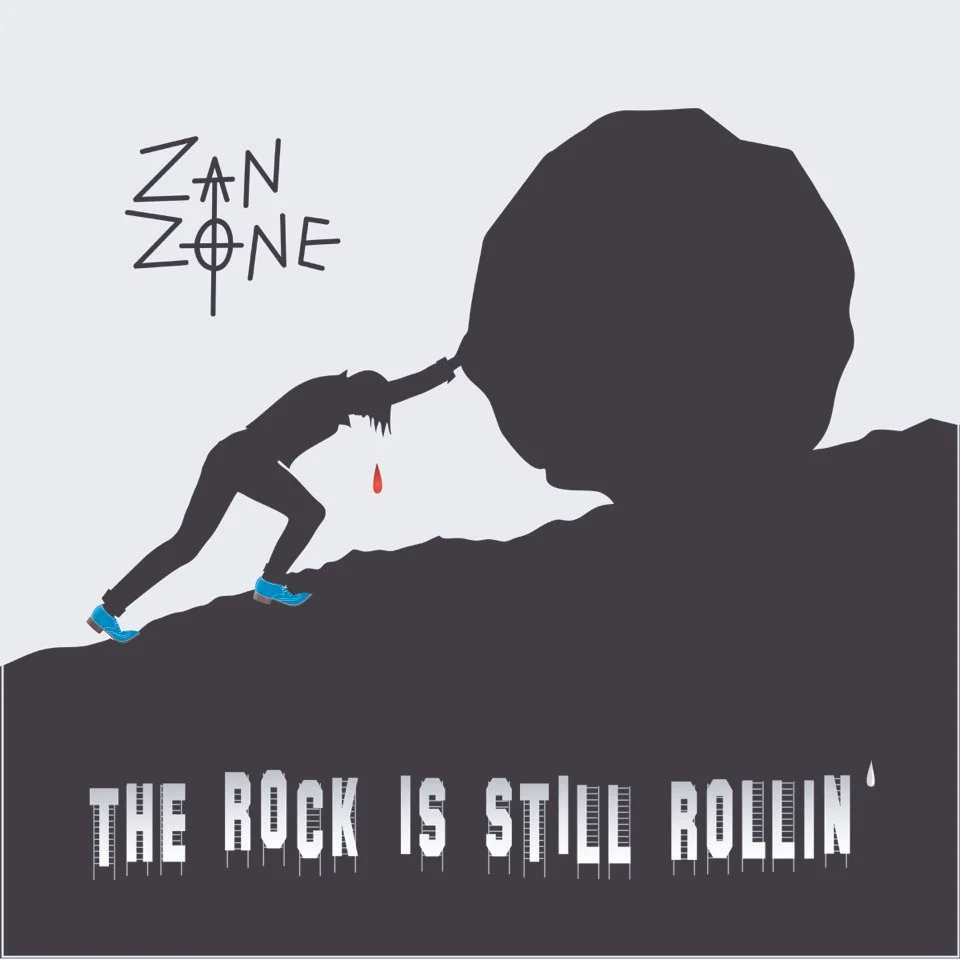
THE ROCK IS STILL ROLLIN’
SONG DESCRIPTIONS
#1 BORN TO ROLL:
The mid to late 1960s brought to the musical world of Rock n’ Roll a more stylistically complex approach than Rock n’ Roll had previously embodied and exhibited. This sub-genre has often been called Progressive Rock, or Prog Rock. It was adapted and displayed - invented, really - by bands such as Yes, Emerson, Lake and Palmer, Pink Floyd, and many others as well, to one degree or another. Even the most popular bands like the Beatles and The Rolling Stones were influenced by the more complicated melodies and arrangements typical of Prog Rock. Here, on the album’s opening track, Born To Roll, Zan Zone presents a six-piece instrumental that reflects and embodies some of the varied approaches that Prog Rock brought to Rock n’ Roll such as wide ranging instrumental music, varying instrumentation and sounds, and high-spirited, virtuosic musicianship.
#2 HAVE SOME FUN TONIGHT:
Digging right into Chuck Berry’s straight ahead and iconic Rock n’ Roll musical style, Have Some Fun Tonight is exactly the kind of song that defines Chuck Berry’s music - and classic Rock n’ Roll.
#3 DOG DAYS:
With a nod to the late 1960s birth of a harder and more aggressive rock approach, especially to the guitar and drum sounds, Dog Days introduces some hard rock flavor to what had been, here-to-fore, merely pop Rock n’ Roll. It even includes a sitar sample, subtly blended in to give a hint of the influence of that era’s embrace of Indian music, as well as hints of acid rock, and psychedelia. And this is all married to a hard driving, tell-all, get-lost-cheater, breakup song. Female empowerment brought to the forefront!
#4 DOUBLE LIFE:
This song, an example of early hard rock, and the hardest rockin’ song on the album, references, for example, Deep Purple’s similarly explosive music with a duel guitar and organ attack, augmented by fiery drums. It also reveals the classic day-job/night-gig dichotomy that so many musicians have had and still have to deal with just to play and perform music.
#5 HARD TO GET:
Hard To Get employs the classic Bo Diddley beat, arranged similarly to the Rolling Stones first hit from 1964, an excellent version itself, of Buddy Holly’s own Bo Diddley beat classic, Not Fade Away. Here, however, Zan Zone’s saxophonist, Keith Gurland, creates an entire sax section typical of some of the 1950s and early 1960s Rock n’ Roll songs that incorporated multiple saxophones. Lyrically, it is a dialogue from one guy to his buddy who has his sights set on asking out the hottest girl around, only to be advised that winning her over may be more challenging than he might like.
#6 MAMA WAS A TRAIN WRECK:
Swampy and emotional - you can just see the cypress trees, the spanish moss, the big birds and the alligators, along with the buzzing mosquitoes of Louisiana’s hot and humid swamps, and, of course, its culture. The slide guitar honors many of the Louisianan and southern-influenced guitarists who’ve come before with a song that, by the end, leaves you drenched, and thankful for the breezes of freedom you feel riding on an old steam engine train, leaving town - and leaving behind any uncomfortable, or just plain bad situations. Written, in this case, from a young girl’s perspective of her dysfunctional parents, it’s confessional, and cathartic, and singer Angela Watson keeps pushing it to a higher and higher level of emotional expression, revelation, and release.
#7 READY TO SAY GOODBYE:
Difficult as relationships may be, we sometimes hold on to them well past the time that we should probably have let them go, all the while waiting for a sign - or what we think will be a determining and deciding factor or moment to make a decision and perhaps, a change. Ready To Say Goodbye, by song’s end, finds that moment. Written and performed as a more modern and sophisticated song, it still sounds like it could have come from the 1970s.
#8 FRIENDS:
So often in relationships, and in life itself, we imagine good things continuing forever. Here, in this 1970s style Rhythm and Blues ballad - and Rn’B is an absolutely fundamental component of Rock n’ Roll - the protagonist randomly runs into a former girlfriend who, decades earlier, he had thought that he was going to spend the rest of his life with, only to have that dream dissolve. Sugar coating the inevitable, he was left with only a nebulous promise to remain friends, even if they were likely never going to see each other ever again. Yet somehow, the memory - and the dream - never completely died, and remained in his heart. Here, many years later, they’re reawakened for one fleeting moment by a random chance encounter.
#9 SHE LEFT ME (THE LOVE I LOST):
Beginnings and endings are key components of life. The longer one lives, the more one experiences things, people, and especially, love, pass away. Those losses or really, any loss, can hurt as profoundly as anything we ever lose in life. Torch songs - slow, lugubrious, gut and heart wrenching - have long been a distinct contribution to sad-song balladry, even occasionally finding a place in the more emotionally extroverted Rock n’ Roll oeuvre. Think: Roy Orbison. At times of utter despair and sadness, nothing else comes as close, or is more appropriate to those expressions, as is a torch song. Hopefully it is also - perhaps - a catharsis to those emotions. A string quartet creates a sound which often pulls on strong emotional heartstrings, and here, it’s a perfect accompaniment to the almost fathomless depth of human feelings of heartache.
#10 THAT FLAME:
Too often, all of us go through the dark night of the soul. At these times, it’s often a good old friend who’s there to help us get through and encourage us to light a candle in the darkness. With a warm and fuzzy harmonica, an instrument that can imitate the caring, concern and even the timbre of a human voice, this folk-rock-like number is a paean to supportive forces.
#11 HAPPY GO LUCKY:
Many rock bands have utilized and presented arrangements and even full songs that have included elements of jazz music to one degree or another. The examples are numerous. This song here, featuring a jaunty saxophone playing an upbeat melody, is designed to go right into your heart, to put some skip in your step, and a smile on your face. Jazz is decidedly NOT dead and given some real life here by, surprisingly, a Rock n’ Roll band. So start skippin’! And let’s see that smile.
#12 ROCKIN’ N’ ROLLIN’ ON DOWN THE ROAD:
All good things must come to an end and eventually, this sing-goodnight encore is happily played right before it’s time to move on, get out of town, and rock n’ roll on down the road. Channeling Chuck Berry once again to close out the record, Rockin’ n’ Rollin’ On Down The Road is Zan Zone’s way of thanking a great audience and honoring the joy that they and band alike just experienced having had a great evening of dancing and grooving to timeless Rock n’ Roll music. And before you too are on your way - tell Tchaikovsky the news!